Myanmar

Myanmar

Monday, November 23, 2026

Myanmar Lashio (AI) on Christian

 In Lashio, the largest town in northern Shan State, Myanmar, Christianity (both Protestant and Catholic) serves as more than just a religious faith it is a vital pillar for education, social welfare, addiction recovery, and wartime humanitarian relief.

Because Lashio is a strategic trade hub near the Chinese border with a diverse population (including Chinese, Kachin, Lisu, Wa, Kokang, and Shan communities), Christian influence in the area is most prominent in five key areas:
1. Preservation of Chinese and Basic Education
Against the backdrop of long-standing government restrictions on ethnic minority and Chinese-language education in Myanmar, church-run schools have become the backbone of local schooling:
  • Christian School Systems: Lashio is home to prominent Christian schools, such as Shengguang Middle School (covering kindergarten through high school). Many of these schools have remained open even during severe political instability, often seeing record enrollment as displaced families flee to the city.
  • Catholic Educational Legacy: Established through foreign missionaries and religious orders (such as the Salesians and De La Salle Brothers) from the late 19th to mid-20th centuries, the Diocese of Lashio founded numerous schools, boarding centers, and catechist training facilities that significantly raised literacy rates in the borderlands.
2. Social Welfare and Care for the Vulnerable
Decades of civil conflict and poverty have left many families broken, prompting local churches and Christian organizations to fill critical gaps in state social services:
  • Orphanages and Child Care: Lashio hosts dozens of gospel institutions and children's homes (such as Enci Home and Muyi Home), which house, educate, and care for thousands of children orphaned or displaced by war and poverty across ethnic lines.
  • Drug Rehabilitation: Located near the Golden Triangle, Lashio faces severe drug abuse challenges. Local churches operate faith-based rehabilitation centers (such as Lashio Home) that help individuals overcome addiction and reintegrate into society.
3. Wartime Humanitarian Relief and Refugee Shelter
During periods of intense armed conflict in northern Shan State (such as the civil war following the 2021 coup and clashes involving ethnic armed organizations), churches act as frontline sanctuaries:
  • Cross-Ethnic Relief Networks: When fighting erupts in surrounding townships or within Lashio itself, local Chinese, Kachin, and Wa churches set aside denominational differences to open their compounds—sheltering thousands of internally displaced persons (IDPs) and coordinating food and medical supply distribution.
4. Ethnic Identity and Community Cohesion
  • Script Creation and Cultural Preservation: Historically, Western missionaries created Romanized scripts and translated the Bible for highland ethnic groups like the Kachin, Lisu, and Lahu, embedding Christianity deeply into their written languages and cultural identities.
  • Hub for the Chinese Diaspora: Facing political limitations in Myanmar, the Chinese community relies on Lashio’s twenty-plus Chinese churches and seminaries not only for spiritual guidance, but also as vital public spaces to preserve Chinese language, culture, and mutual aid networks.
5. Regional Hub for Missions and Church Networks
Due to its geographic accessibility, Lashio acts as the central nerve center for Christian networks across northern Myanmar:
  • Interdenominational Unity: The city hosts the Upper Myanmar United Prayer Fellowship and several theological seminaries, regularly bringing together hundreds of pastors from different ethnic and denominational backgrounds. It also serves as a primary staging ground for overseas churches (from Taiwan, Singapore, and North America) conducting medical and educational outreach in Myanmar.

Monday, November 4, 2024

How Myanmar’s Civil War Could Actually End

How Myanmar’s Civil War Could Actually End

By By Koh Ewe


An explosion occurs during a bombardment carried out by Myanmar’s military in Lashio, the largest urban center to fall to any of Myanmar’s myriad ethnic minority armed groups who have been fighting the central authorities on and off for decades, in Myanmar’s northern Shan State on Sept. 24, 2024

www.time.com


https://time.com/7160736/myanmar-coup-civil-war-conflict-timeline-endgame-explainer/


How Myanmar’s Civil War Could Actually End


Monday, December 4, 2023

Opponents vow ‘beginning of the end’ for Myanmar’s junta as resistance launches nationwide offensive

 https://www.cnn.com/2023/11/28/asia/myanmar-nationwide-offensive-junta-intl-hnk


Opponents vow ‘beginning of the end’ for Myanmar’s junta as resistance launches nationwide offensive  


By , Salai TZ,  and , CNN

Updated 3:29 AM EST, Tue November 28, 2023


CNN — 

Almost three years on from its bloody coup, Myanmar’s military junta is facing the biggest threat to its hold on power as it fights wars on multiple fronts across the Southeast Asian nation.

In recent weeks, powerful armed ethnic militias have joined with resistance forces to mount major new offensives with unprecedented coordination, exposing the limits of the deeply unpopular junta’s capabilities as it loses strategic border towns, key military positions and vital trade routes at a scale not seen in decades, according to experts.

“The junta is actively collapsing right now and that’s only become possible because there is this wider effort across the country,” said Matthew Arnold, an independent Myanmar analyst. ……………

Tuesday, November 8, 2022

Burmese army bombs Baptist Seminary, students hit by shrapnel

https://www.christianpost.com/news/burmese-army-bombs-baptist-seminary-students-hit-by-shrapnel.html

Burmese army bombs Baptist Seminary, students hit by shrapnel
 By Anugrah Kumar, Christian Post Contributor 

https://cdn.christianpost.com/images/cache/image/14/37/143765_w_760_507.webp


Myanmar's military junta bombed a Baptist seminary in Shan State, injuring at least four men in the dormitory. 

The army, locally known as the Tatmadaw, shelled the Theological Seminary in the Kutkai area of Shan State on Thursday, the U.S.-based persecution watchdog International Christian Concern reported.

Four men, aged between 21 and 27, were hit by shrapnel and sustained non-life-threatening injuries while they were in the dormitory of the school which the Kachin Baptist Convention founded.

Formerly known as Burma, the Southeast Asian country is home to the world’s longest Civil War, which began in 1948.

The conflict between the Tatmadaw and ethnic minority militias escalated after the February 2021 military coup, as the ethnic militias have been supporting pro-democracy protesters. The conflict zones are along Myanmar’s borders with India, Thailand and China.

A video posted to social media showed damage caused by the shelling. Visible holes and dents could be seen on the windows, walls and students' clothing. Another video showed an injured student being escorted out for medical treatment.

A local resident was quoted as saying that this kind of attack by the military threatens the Christian Bible school and the entire Kachin nation.

Christians make up just over 7% of the majority-Buddhist nation but are a majority in Chin State, which borders India, and Kachin State, which borders China. Christians also make up a substantial part of the population of Kayah State, which borders Thailand.

“The attack against this Kachin Bible school was certainly not an accident,” said Gina Goh, ICC’s regional manager for Southeast Asia. “Instead, the Tatmadaw deliberately targeted a Christian facility knowing how important the faith is to Kachin people. This despicable junta regime should not be tolerated any further by the international community and needs to be removed at once.”

The shelling of the Baptist seminary comes after a separate attack on Oct. 23 when at least 80 people, including leading Kachin musicians, were killed in the junta’s aerial bombing of a concert in Kachin State’s Hpaknat township, according to UCA News. The tragedy prompted many people to “black out their profile photo on Facebook to show sorrow for the victims and solidarity with ethnic Kachin people.

The concert was to celebrate the 62nd anniversary of the founding of the Kachin Independence Organization, the political wing of the Kachin Independence Army, which hundreds of people attended, including members of the KIA.

More than 2,400 people have been killed, and over 16,000 people have been jailed and tortured by the Tatmadaw, ICC noted.

In June, multiple reports, including by the U.N., revealed that Myanmar’s Buddhist nationalist junta had disproportionately targeted religious minorities, including Christians, and brutally attacked and killed hundreds of children since the military coup.

Tom Andrews, the U.N. special rapporteur on the situation of human rights in Myanmar, said in a report at the time that “the junta’s relentless attacks on children underscore the generals’ depravity and willingness to inflict immense suffering on innocent victims in its attempt to subjugate the people of Myanmar.”

Focusing on the killing of children, the U.N. rapporteur said during his fact-finding for the report, “I received information about children who were beaten, stabbed, burned with cigarettes, and subjected to mock executions, and who had their fingernails and teeth pulled out during lengthy interrogation sessions.”

Since the coup, the military had killed at least 142 children in Myanmar, the U.N. report added.


Sunday, January 31, 2021

Myanmar military takes control of country after detaining Aung San Suu Kyi

Myanmar military takes control of country after detaining Aung San Suu Kyi 
BBC News

Myanmar's military has taken control of the country after Aung San Suu Kyi and other political leaders were arrested in the early hours.

Hours after the arrests, military TV confirmed a state of emergency had been declared for one year.

The coup comes after tensions rose between the civilian government and the military following a disputed election.

Myanmar, also known as Burma, was ruled by the military until democratic reforms began in 2011.

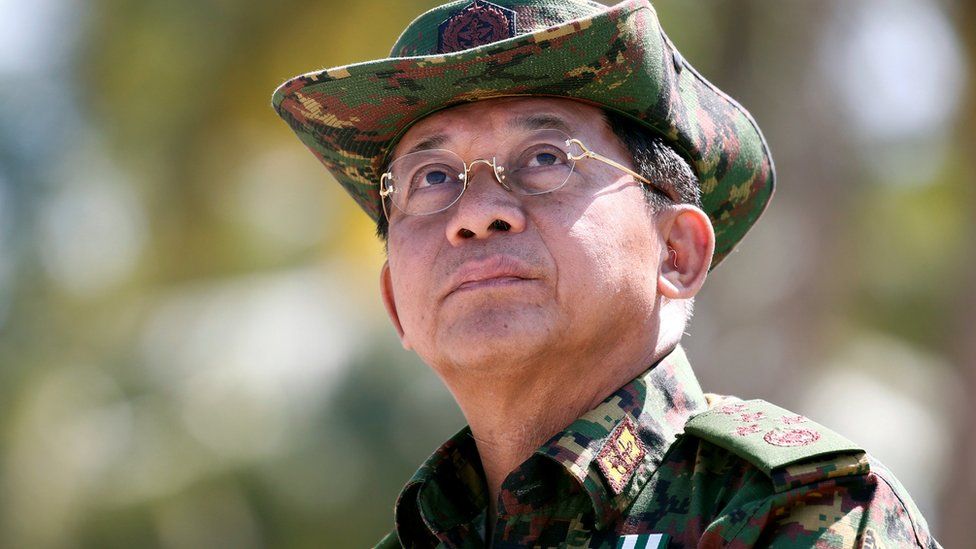
The military said on Monday it was handing power to commander-in-chief Min Aung Hlaing. Soldiers are on the streets of the capital, Nay Pyi Taw, and the main city, Yangon.

In November's election, Ms Suu Kyi's National League for Democracy (NLD) won enough seats to form a government. The army says the vote was fraudulent.

The BBC's South East Asia correspondent, Jonathan Head, says the coup appears to be a clear violation of the constitution drafted by the military more than a decade ago, and which it promised to honour only on Saturday.

Detaining political leaders like Ms Suu Kyi is a provocative and very risky move, one which may well be strongly opposed, our correspondent says.

.......


Military chief Min Aung Hlaing has taken the reigns